Metal Units (NPT Simulation)#
This notebook demonstrates the use of a unit system (metal units) for the simulation of the Silicon crystal containing 512 atoms in the NPT ensemble with the Stillinger-Weber potential. This notebook use lammps velocities and positions as a starting point for the simulation and for comparison.
More about the unit system https://docs.lammps.org/units.html
Imports & Utils#
[1]:
import os

IN_COLAB = 'COLAB_RELEASE_TAG' in os.environ
if IN_COLAB:
  import subprocess
  import sys

  subprocess.run(
    [
      sys.executable,
      '-m',
      'pip',
      'install',
      '-q',
      'git+https://github.com/jax-md/jax-md.git',
    ]
  )

import jax.numpy as jnp
import numpy as onp
from jax import debug
from jax import jit
from jax import grad
from jax import random
from jax import lax
from jax import config

config.update('jax_enable_x64', True)
from jax_md import simulate
from jax_md import space
from jax_md import energy
from jax_md import elasticity
from jax_md import quantity
from jax_md import dataclasses
from jax_md.util import f64

# Other libraries
import matplotlib
import matplotlib.pyplot as plt
import pandas as pd
Download LAMMPS Data#
[2]:
# LAMMPS simulation data for comparison
import urllib.request

SMOKE_TEST = os.environ.get('READTHEDOCS', False)


def download_file(url, filename):
  if not os.path.exists(filename):
    urllib.request.urlretrieve(url, filename)


base_url = 'https://raw.githubusercontent.com/abhijeetgangan/silicon_data/main/Si_FF/Si_SW_MD/NPT_300K/'
download_file(base_url + 'lammps_npt.dat', 'lammps_npt.dat')

# Download initial positions from NVE simulation
base_url_nve = 'https://raw.githubusercontent.com/abhijeetgangan/silicon_data/main/Si_FF/Si_SW_MD/NVE_300K/'
download_file(base_url_nve + 'step_1.traj', 'step_1.traj')

data_lammps = pd.read_csv('lammps_npt.dat', sep=r'\s+', header=None)
data_lammps = data_lammps.dropna(axis=1)
data_lammps.columns = ['Time', 'T', 'P', 'V', 'E', 'H']
t_l, T, P, V, E, H = (
  data_lammps['Time'],
  data_lammps['T'],
  data_lammps['P'],
  data_lammps['V'],
  data_lammps['E'],
  data_lammps['H'],
)
Load LAMMPS Positions and Velocities#
[3]:
lammps_step_0 = onp.loadtxt('step_1.traj', dtype=f64)
[4]:
# Load positions from lammps
positions = jnp.array(lammps_step_0[:, 2:5], dtype=f64)
# Load velocities from lammps
velocity = jnp.array(lammps_step_0[:, 5:8], dtype=f64)
latvec = jnp.array(
  [
    [21.724, 0.000000, 0.000000],
    [0.00000, 21.724, 0.00000],
    [0.00000, 0.0000, 21.724],
  ]
)
Units and Simulation Parameters#
[5]:
# Import unit system
from jax_md import units

# Metal units
unit = units.metal_unit_system()
[6]:
# Simulation parameters
timestep = 1e-3
fs = timestep * unit['time']
ps = unit['time']
dt = fs
write_every = 100
box = latvec
T_init = 300 * unit['temperature']
P_init = 0.0 * unit['pressure']
Mass = 28.0855 * unit['mass']
key = random.PRNGKey(121)

NSTEPS_SIM = 1000 if SMOKE_TEST else 50000
[7]:
# Logger to save data
log = {
  'E': jnp.zeros((NSTEPS_SIM // write_every,)),
  'P': jnp.zeros((NSTEPS_SIM // write_every,)),
  'T': jnp.zeros((NSTEPS_SIM // write_every,)),
  'kT': jnp.zeros((NSTEPS_SIM // write_every,)),
}
Simulation Setup#
[8]:
# Setup the periodic boundary conditions.
displacement, shift = space.periodic_general(latvec)
dist_fun = space.metric(displacement)
neighbor_fn, energy_fn = energy.stillinger_weber_neighbor_list(
  displacement, latvec, disable_cell_list=True
)
energy_fn = jit(energy_fn)
[9]:
# Thermostat and barostat parameters same as LAMMPS
from typing import Dict


def default_nhc_kwargs(tau: f64, overrides: Dict) -> Dict:
  default_kwargs = {
    'chain_length': 3,
    'chain_steps': 1,
    'sy_steps': 1,
    'tau': tau,
  }
  if overrides is None:
    return default_kwargs
  return {
    key: overrides.get(key, default_kwargs[key]) for key in default_kwargs
  }


new_kwargs = {
  'chain_length': 3,
  'chain_steps': 1,
  'sy_steps': 1,
}
[10]:
# Extra capacity to prevent overflow
nbrs = neighbor_fn.allocate(positions, box=box, extra_capacity=2)

# NPT simulation
init_fn, apply_fn = simulate.npt_nose_hoover(
  energy_fn,
  shift,
  dt=dt,
  pressure=P_init,
  kT=T_init,
  barostat_kwargs=default_nhc_kwargs(1000 * dt, new_kwargs),
  thermostat_kwargs=default_nhc_kwargs(100 * dt, new_kwargs),
)
apply_fn = jit(apply_fn)
state = init_fn(key, positions, box=box, neighbor=nbrs, kT=T_init, mass=Mass)

# Restart from LAMMPS velocities
state = dataclasses.replace(state, momentum=Mass * velocity * unit['velocity'])
/home/docs/checkouts/readthedocs.org/user_builds/jax-md/envs/main/lib/python3.12/site-packages/jax/_src/ops/scatter.py:105: FutureWarning: scatter inputs have incompatible types: cannot safely cast value from dtype=int64 to dtype=int32 with jax_numpy_dtype_promotion=standard. In future JAX releases this will result in an error.
  warnings.warn(
NPT Simulation#
[11]:
@jit
def step_fn(i, state_nbrs_box):
  state, nbrs, box = state_nbrs_box
  # Take a simulation step.
  t = i * dt
  state = apply_fn(state, neighbor=nbrs, kT=T_init, pressure=P_init)
  box = simulate.npt_box(state)
  nbrs = nbrs.update(state.position, neighbor=nbrs, box=box)
  return state, nbrs, box


@jit
def outer_sim_fn(j, state_nbrs_log_box):
  state, nbrs, log, box = state_nbrs_log_box

  # Quantities to calculate
  K = quantity.kinetic_energy(momentum=state.momentum, mass=Mass)
  E = energy_fn(state.position, box=box, neighbor=nbrs)
  kT = quantity.temperature(momentum=state.momentum, mass=Mass)
  P = quantity.pressure(energy_fn, state.position, box, K, neighbor=nbrs)

  # Save the quantities
  log['T'] = (
    log['T']
    .at[j]
    .set(
      simulate.npt_nose_hoover_invariant(
        energy_fn, state, pressure=P_init, kT=T_init, neighbor=nbrs
      )
    )
  )
  log['E'] = log['E'].at[j].set(E)
  log['kT'] = log['kT'].at[j].set(kT)
  log['P'] = log['P'].at[j].set(P)

  # Print the quantities
  debug.print('Step = {j} | Total Energy = {T}', j=j * write_every, T=K + E)

  @jit
  def inner_sim_fn(i, state_nbrs_box):
    return step_fn(i, state_nbrs_box)

  state, nbrs, box = lax.fori_loop(
    0, write_every, inner_sim_fn, (state, nbrs, box)
  )

  return state, nbrs, log, box
[12]:
state_r, nbrs_r, log_r, box_r = lax.fori_loop(
  0, int(NSTEPS_SIM / write_every), outer_sim_fn, (state, nbrs, log, box)
)
Step = 0 | Total Energy = -2200.482656138204
Step = 100 | Total Energy = -2198.4224175433724
Step = 200 | Total Energy = -2194.9085484995753
Step = 300 | Total Energy = -2190.678638451719
Step = 400 | Total Energy = -2186.1775687274717
Step = 500 | Total Energy = -2182.026456320522
Step = 600 | Total Energy = -2178.6748083692573
Step = 700 | Total Energy = -2177.7207393334147
Step = 800 | Total Energy = -2179.182955958282
Step = 900 | Total Energy = -2181.31954475668
[13]:
# Check if neighbors overflowed
print(nbrs_r.did_buffer_overflow)
0
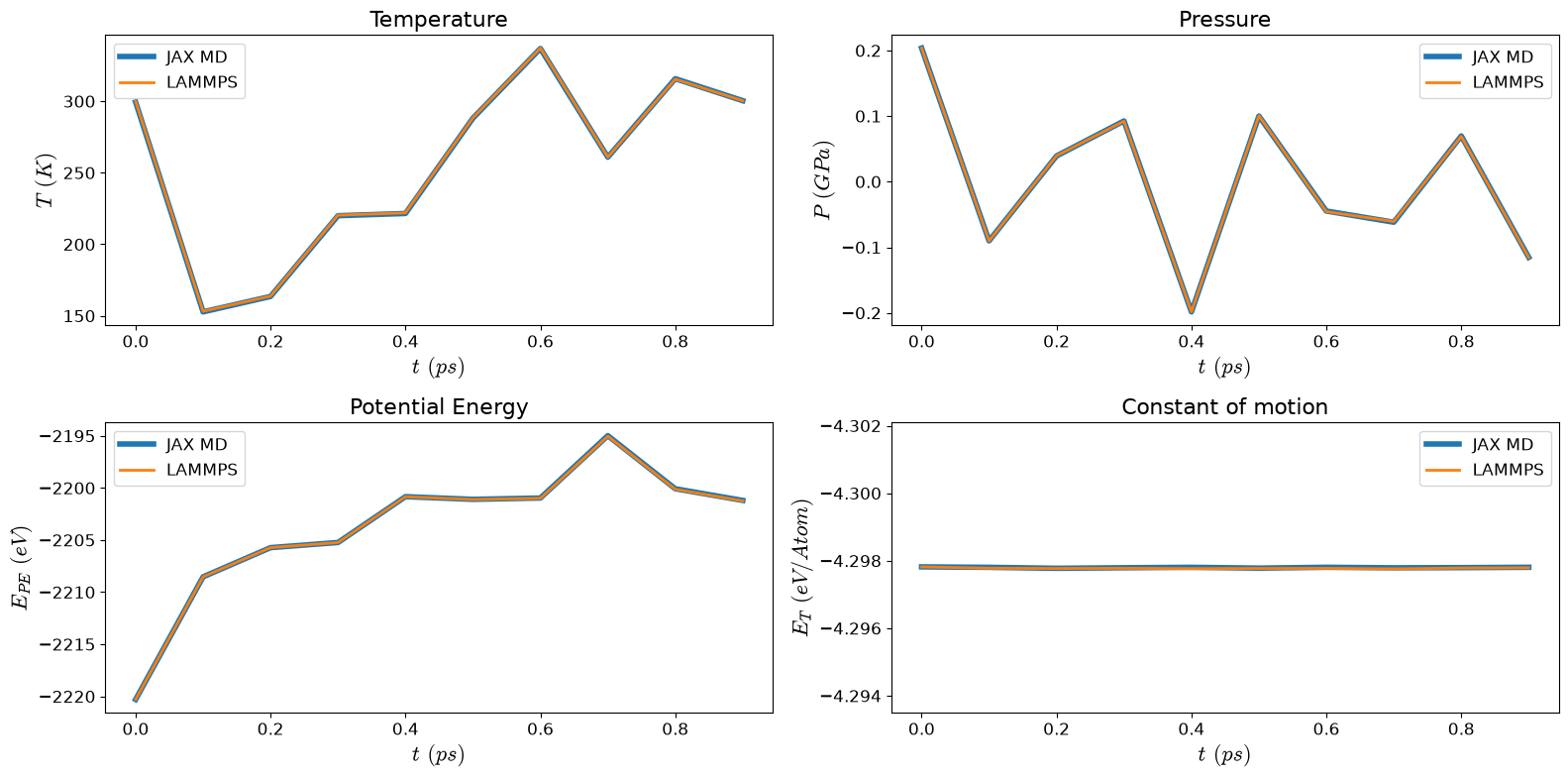
Comparison Plot#
Note that you have to reconvert the units again.
[14]:
NSTEPS = int(NSTEPS_SIM / write_every)
t = jnp.arange(0, NSTEPS, dtype=f64) * timestep * write_every
[15]:
matplotlib.rcParams['mathtext.fontset'] = 'cm'
matplotlib.rcParams.update({'font.size': 12})
fig = plt.figure(figsize=(16, 8))

ax1 = plt.subplot(2, 2, 1)
ax1.plot(t, log_r['kT'] / unit['temperature'], lw=4, label='JAX MD')
if data_lammps is not None:
  ax1.plot(t_l[:NSTEPS], T[:NSTEPS], lw=2, label='LAMMPS')
ax1.set_title('Temperature', fontsize=16)
ax1.set_ylabel('$T\\ (K)$', fontsize=16)
ax1.set_xlabel('$t\\ (ps)$', fontsize=16)
ax1.legend()

ax2 = plt.subplot(2, 2, 2)
ax2.plot(t, (log_r['P'] / unit['pressure']) / 10000, lw=4, label='JAX MD')
if data_lammps is not None:
  ax2.plot(t_l[:NSTEPS], P[:NSTEPS] / 10000, lw=2, label='LAMMPS')
ax2.set_title('Pressure', fontsize=16)
ax2.set_ylabel('$P\\ (GPa)$', fontsize=16)
ax2.set_xlabel('$t\\ (ps)$', fontsize=16)
ax2.legend()

ax3 = plt.subplot(2, 2, 3)
ax3.plot(t, log_r['E'], lw=4, label='JAX MD')
if data_lammps is not None:
  ax3.plot(t_l[:NSTEPS], E[:NSTEPS], lw=2, label='LAMMPS')
ax3.set_title('Potential Energy', fontsize=16)
ax3.set_ylabel('$E_{PE}\\ (eV)$', fontsize=16)
ax3.set_xlabel('$t\\ (ps)$', fontsize=16)
ax3.legend()

ax4 = plt.subplot(2, 2, 4)
ax4.plot(t, log_r['T'] / 512, lw=4, label='JAX MD')
if data_lammps is not None:
  ax4.plot(t_l[:NSTEPS], H[:NSTEPS] / 512, lw=2, label='LAMMPS')
ax4.set_title('Constant of motion', fontsize=16)
ax4.set_ylabel('$E_{T}\\ (eV/Atom)$', fontsize=16)
ax4.set_xlabel('$t\\ (ps)$', fontsize=16)
ax4.set_ylim(
  jnp.mean(log_r['T'] / 512) - jnp.mean(log_r['T'] / 512) / 1000,
  jnp.mean(log_r['T'] / 512) + jnp.mean(log_r['T'] / 512) / 1000,
)
ax4.legend()

fig.tight_layout()
plt.show()
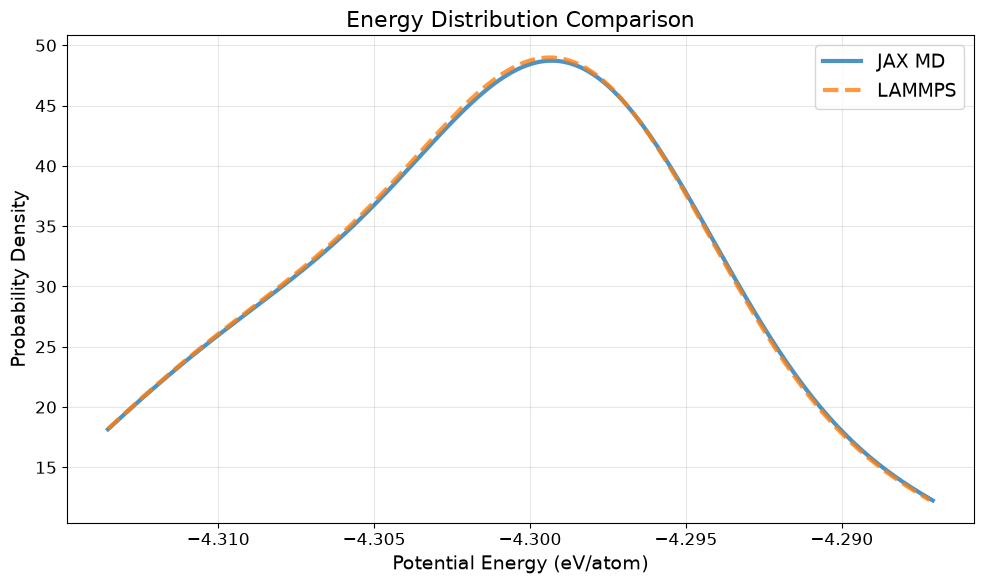
Energy Distribution Comparison#
Compare the distribution of total energies between JAX-MD and LAMMPS
[16]:
from scipy import stats

# Skip first few points for equilibration
NSKIP = 1

# Calculate KDE for smooth distribution
jax_energy = onp.array(log_r['E'][NSKIP:] / 512)
kde_jax = stats.gaussian_kde(jax_energy)
x_range = onp.linspace(jax_energy.min(), jax_energy.max(), 200)

plt.figure(figsize=(10, 6))
plt.plot(x_range, kde_jax(x_range), linewidth=3, label='JAX MD', alpha=0.8)

if data_lammps is not None:
  lammps_energy = onp.array(E[NSKIP:NSTEPS] / 512)
  kde_lammps = stats.gaussian_kde(lammps_energy)
  x_range_lammps = onp.linspace(lammps_energy.min(), lammps_energy.max(), 200)
  plt.plot(
    x_range_lammps,
    kde_lammps(x_range_lammps),
    linewidth=3,
    label='LAMMPS',
    alpha=0.8,
    linestyle='--',
  )

plt.xlabel('Potential Energy (eV/atom)', fontsize=14)
plt.ylabel('Probability Density', fontsize=14)
plt.title('Energy Distribution Comparison', fontsize=16)
plt.legend(fontsize=14)
plt.grid(True, alpha=0.3)
plt.tight_layout()
plt.show()