OPLSAA Torsion Scan#
This example demonstrates loading a CHARMM molecule with the OPLSAA force field, performing a torsion scan around a bond, and computing energies and forces at each angle.
Imports#
[1]:
from collections import deque
from pathlib import Path

import jax.numpy as jnp
from jax import jit, grad
import matplotlib.pyplot as plt
import networkx as nx
import numpy as np

from jax_md.mm_forcefields import oplsaa
from jax_md.mm_forcefields.nonbonded.electrostatics import PMECoulomb
from jax_md.mm_forcefields.base import NonbondedOptions

DATA_DIR = Path(__file__).resolve().parent / 'data' / 'torsion-data' \
  if '__file__' in dir() else Path('data/torsion-data')
Load CHARMM System#
[2]:
positions, topology, parameters = oplsaa.load_charmm_system(
  str(DATA_DIR / 'scan_1.pdb'),
  str(DATA_DIR / 'scan_1.prm'),
  str(DATA_DIR / 'scan_1.rtf'),
)

for k, v in topology._asdict().items():
  print(f"{k}: {f'shape={v.shape}' if hasattr(v, 'shape') else v}")
n_atoms: 22
bonds: shape=(23, 2)
angles: shape=(36, 3)
torsions: shape=(52, 4)
impropers: shape=(12, 4)
exclusion_mask: shape=(22, 22)
pair_14_mask: shape=(22, 22)
molecule_id: shape=(22,)
cmap_atoms: None
cmap_map_idx: None
exc_pairs: None
nbfix_atom_type: None
Visualize Molecule Graph#
[3]:
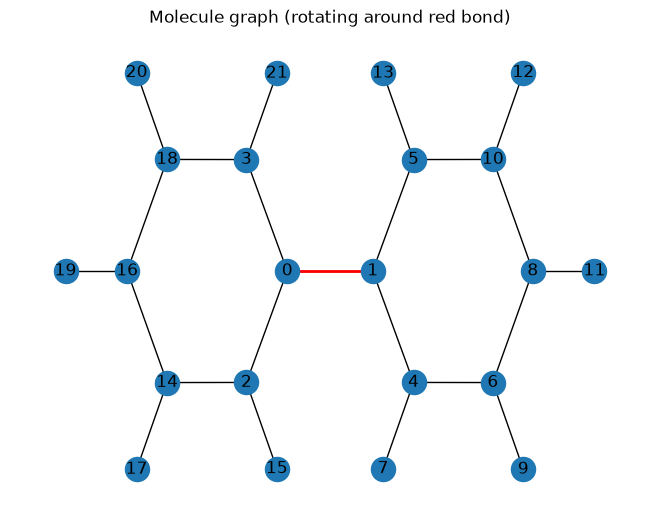
pos_2d = positions[:, :2]
bonds = topology.bonds

G = nx.Graph()
G.add_nodes_from(range(topology.n_atoms))
G.add_edges_from(bonds.tolist())

nx.draw(G, pos=pos_2d, with_labels=True)
nx.draw_networkx_edges(G, pos_2d, edgelist=[(0, 1)], edge_color='red', width=2)
plt.title('Molecule graph (rotating around red bond)')
plt.show()
Setup Energy Function#
Create the OPLSAA energy function with PME electrostatics.
[4]:
coords_range = jnp.max(positions, axis=0) - jnp.min(positions, axis=0)
box_size = coords_range + 20.0
box = jnp.array([box_size[0], box_size[1], box_size[2]])

nb_options = NonbondedOptions(
  r_cut=12.0,
  dr_threshold=0.5,
  scale_14_lj=0.5,
  scale_14_coul=0.5,
  use_soft_lj=False,
  use_shift_lj=False,
)

coulomb = PMECoulomb(grid_size=32, alpha=0.3, r_cut=12.0)

energy_fn, neighbor_fn, displacement_fn = oplsaa.energy(
  topology, parameters, box, coulomb, nb_options
)
energy_fn_jit = jit(energy_fn)
[5]:
nlist = neighbor_fn.allocate(positions)
E_init = energy_fn_jit(positions, nlist)
for k, v in E_init.items():
  print(f"{k}: {v}")
angle: 0.24455878138542175
bond: 1.4150346517562866
coulomb: -1.144989013671875
improper: 0.0109158456325531
lj: 11.883728981018066
torsion: 0.0
total: 12.409249305725098
Torsion Scan Utilities#
[6]:
def find_bond_sides(bonds, bond_idx_to_break):
  n_atoms = int(bonds.max()) + 1
  bond_i, bond_j = bond_idx_to_break

  adjacency = [set() for _ in range(n_atoms)]
  for atom1, atom2 in bonds:
    atom1, atom2 = atom1.item(), atom2.item()
    if (atom1 == bond_i and atom2 == bond_j) or \
       (atom1 == bond_j and atom2 == bond_i):
      continue
    adjacency[atom1].add(atom2)
    adjacency[atom2].add(atom1)

  def bfs(start):
    side = set()
    queue = deque([start])
    visited = {start}
    while queue:
      atom = queue.popleft()
      side.add(atom)
      for neighbor in adjacency[atom]:
        if neighbor not in visited:
          visited.add(neighbor)
          queue.append(neighbor)
    return side

  return bfs(bond_i), bfs(bond_j)


def set_dihedral_angle(pos, bonds, bond_atoms, target_angle_deg):
  pos = jnp.array(pos)
  i, j = bond_atoms
  _, side2 = find_bond_sides(bonds, bond_atoms)
  axis_vec = pos[j] - pos[i]
  axis_vec = axis_vec / jnp.linalg.norm(axis_vec)
  center = pos[i]
  angle_rad = jnp.radians(target_angle_deg)

  def rotate_point(p, axis, angle, center):
    p_shifted = p - center
    cos_a = jnp.cos(angle)
    sin_a = jnp.sin(angle)
    p_rot = (
      p_shifted * cos_a
      + jnp.cross(axis, p_shifted) * sin_a
      + axis * jnp.dot(axis, p_shifted) * (1 - cos_a)
    )
    return p_rot + center

  new_pos = pos.copy()
  for atom_idx in side2:
    if atom_idx != i:
      new_pos = new_pos.at[atom_idx].set(
        rotate_point(pos[atom_idx], axis_vec, angle_rad, center)
      )
  return new_pos


bonds_array = jnp.array(topology.bonds)
sidea, sideb = find_bond_sides(bonds_array, (0, 1))
Visualize Rotated Conformations#
[7]:
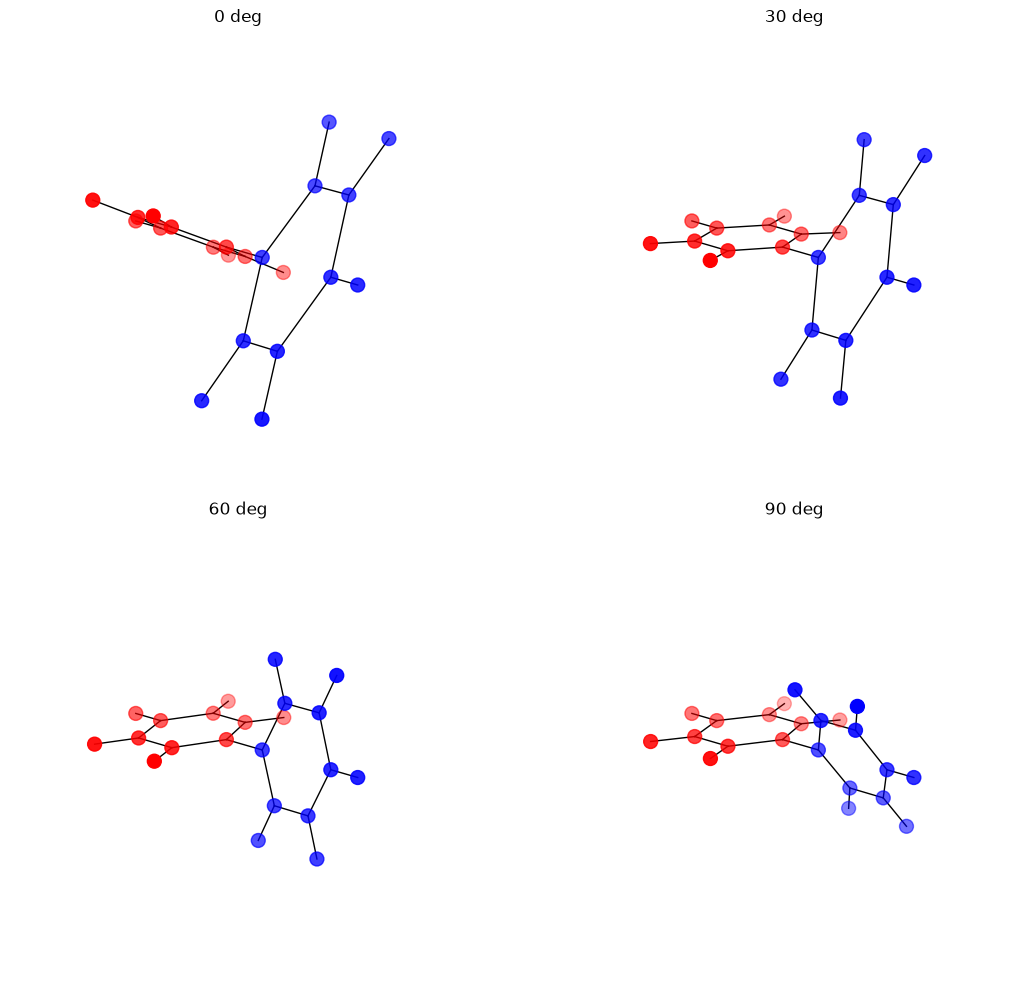
fig = plt.figure(figsize=(12, 10))
angles_to_plot = jnp.linspace(0, 90, 4)
for idx, angle in enumerate(angles_to_plot, 1):
  pos = set_dihedral_angle(positions, bonds_array, (0, 1), angle)
  ax = fig.add_subplot(2, 2, idx, projection='3d')
  colors = ['red' if i in sidea else 'blue' for i in range(len(pos))]
  ax.scatter(*pos.T, c=colors, s=100)
  for bond in bonds_array:
    bi, bj = bond
    ax.plot(
      [pos[bi, 0], pos[bj, 0]],
      [pos[bi, 1], pos[bj, 1]],
      [pos[bi, 2], pos[bj, 2]], 'k-', linewidth=1,
    )
  ax.set_title(f'{angle:.0f} deg')
  ax.set_axis_off()
plt.tight_layout()
plt.show()
Torsion Scan#
[8]:
step = 5
angles_deg = jnp.arange(0, 181, step)
energies = []
nlist = neighbor_fn.allocate(positions)

print('Performing torsion scan...')
for angle_deg in angles_deg:
  pos_rotated = set_dihedral_angle(positions, bonds_array, [0, 1], angle_deg)
  pos_rotated_jax = jnp.array(pos_rotated)
  nlist = neighbor_fn.update(pos_rotated_jax, nlist)
  E = energy_fn_jit(pos_rotated_jax, nlist)
  energies.append(float(E['total']))
  if angle_deg % 30 == 0:
    print(f"  {angle_deg:3.0f} deg: E = {E['total']:>10.4f} kcal/mol")

energies = jnp.array(energies)
E_ref = energies[0]
rel_energies = energies - E_ref

e_argmin = rel_energies.argmin()
e_argmax = rel_energies.argmax()

print(f'\nScan complete!')
print(f'Min energy: {rel_energies[e_argmin]:.4f} kcal/mol at {angles_deg[e_argmin]:.0f} deg')
print(f'Max relative energy: {rel_energies[e_argmax]:.4f} kcal/mol at {angles_deg[e_argmax]:.0f} deg')

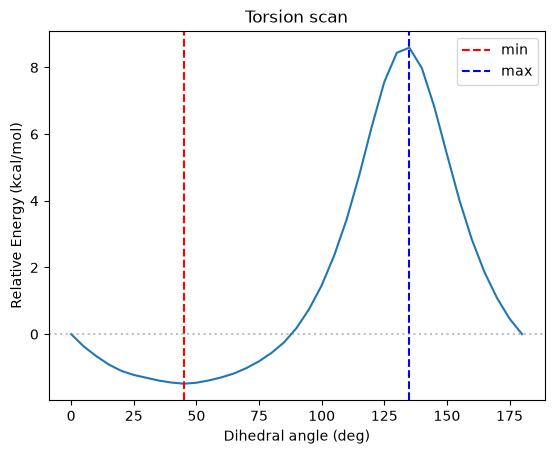
plt.figure()
plt.plot(angles_deg, rel_energies)
plt.xlabel('Dihedral angle (deg)')
plt.ylabel('Relative Energy (kcal/mol)')
plt.title('Torsion scan')
plt.axvline(angles_deg[e_argmin].item(), color='red', linestyle='--', label='min')
plt.axvline(angles_deg[e_argmax].item(), color='blue', linestyle='--', label='max')
plt.axhline(0, color='gray', linestyle=':', alpha=0.5)
plt.legend()
plt.show()
Performing torsion scan...
    0 deg: E =    12.4093 kcal/mol
   30 deg: E =    11.1009 kcal/mol
   60 deg: E =    11.1132 kcal/mol
   90 deg: E =    12.5957 kcal/mol
  120 deg: E =    18.6353 kcal/mol
  150 deg: E =    17.8069 kcal/mol
  180 deg: E =    12.4093 kcal/mol

Scan complete!
Min energy: -1.4864 kcal/mol at 45 deg
Max relative energy: 8.5937 kcal/mol at 135 deg
Forces#
[9]:
def e_total_func(pos, nlist):
  return energy_fn_jit(pos, nlist)['total']

force_fn = jit(grad(e_total_func))
nlist = neighbor_fn.allocate(positions)
forces = force_fn(positions, nlist)
[10]:
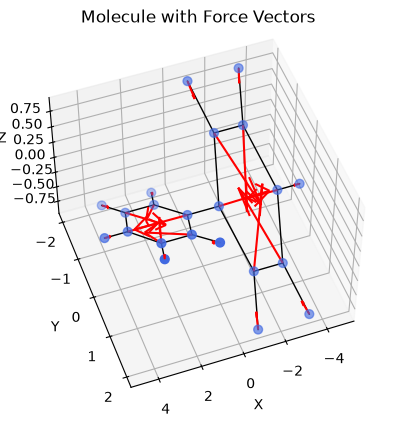
fig = plt.figure()
ax = fig.add_subplot(111, projection='3d')

ax.scatter(positions[:, 0], positions[:, 1], positions[:, 2],
           s=40, c='royalblue')

for bi, bj in bonds_array:
  ax.plot(
    [positions[bi, 0], positions[bj, 0]],
    [positions[bi, 1], positions[bj, 1]],
    [positions[bi, 2], positions[bj, 2]], 'k-', linewidth=1,
  )

scale = 0.08
for p, f in zip(np.array(positions), np.array(forces)):
  ax.quiver(p[0], p[1], p[2],
            f[0] * scale, f[1] * scale, f[2] * scale,
            color='red')

ax.set_xlabel('X')
ax.set_ylabel('Y')
ax.set_zlabel('Z')
ax.set_title('Molecule with Force Vectors')
ax.view_init(elev=50, azim=70)
plt.show()