Equivariant Neural Network Potentials#
This example demonstrates how to train and deploy an equivariant graph neural network potential for Silicon using JAX MD. The model is NequIPEnergyModel from jax_md._nn.nequip, used via the nequip_neighbor_list convenience wrapper from jax_md.energy. After training on DFT energies and forces, we use the learned potential for FIRE minimization, stress computation, and an NVT simulation.
Imports#
[1]:
import os
import pickle
import tempfile
import urllib.request
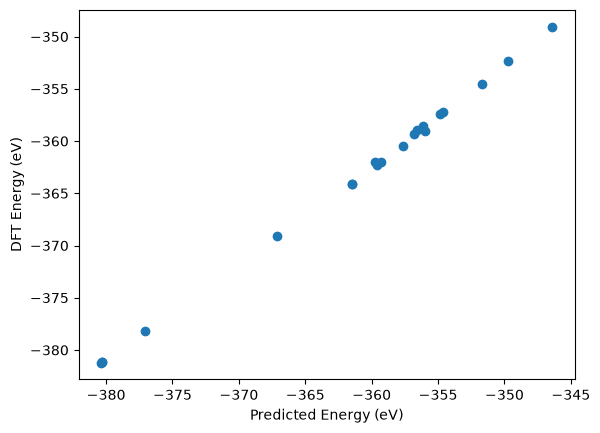
from functools import partial
from pathlib import Path

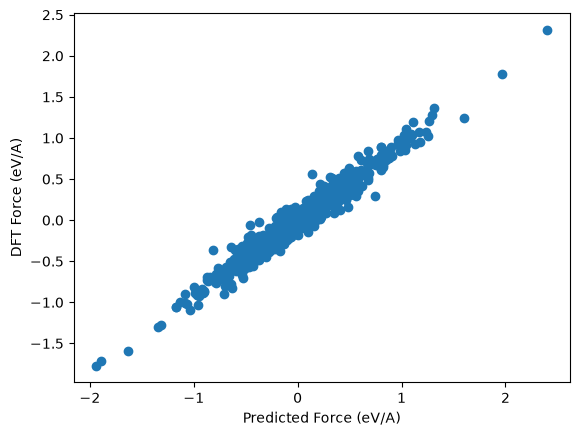
import warnings
warnings.simplefilter('ignore')

from tqdm import tqdm

import jax
import jax.numpy as jnp
import numpy as onp
from jax import random, jit, grad, vmap, value_and_grad
import matplotlib.pyplot as plt
import optax
from ml_collections import ConfigDict

from jax_md import space, partition, quantity, energy, minimize, simulate, units
from jax_md import custom_partition

def _find_models_dir():
  """Find the models directory regardless of working directory."""
  candidates = [
    Path(__file__).resolve().parent / 'models' if '__file__' in dir() else None,
    Path('models'),
    Path('examples/models'),
    Path('docs/examples/models'),
  ]
  for p in candidates:
    if p is not None and p.exists():
      return p
  return Path('models')

MODELS_DIR = _find_models_dir()

SMOKE_TEST = os.environ.get('READTHEDOCS', False)
Download Data#
We start with different phases of Silicon computed using DFT. The dataset contains 2416 training and 1302 validation configurations of 64 atoms each, with energies and forces.
[2]:
CACHE_DIR = Path(tempfile.gettempdir()) / 'jax_md_equivariant'
DATA_PATH = CACHE_DIR / 'silicon_train.npz'
DATA_URL = 'https://www.dropbox.com/s/3dojk4u4di774ve/silica_train.npz?dl=1'

CACHE_DIR.mkdir(parents=True, exist_ok=True)
if not DATA_PATH.exists():
  print(f'Downloading {DATA_URL} -> {DATA_PATH}')
  urllib.request.urlretrieve(DATA_URL, DATA_PATH)

with open(DATA_PATH, 'rb') as f:
  files = onp.load(f)
  Rs = jax.device_put(files['arr_0'])
  Es = jax.device_put(files['arr_1'])
  Fs = jax.device_put(files['arr_2'])
  val_Rs = jax.device_put(files['arr_3'][:400])
  val_Es = jax.device_put(files['arr_4'][:400])
  val_Fs = jax.device_put(files['arr_5'][:400])
  if SMOKE_TEST:
    Rs = Rs[:20]
    Es = Es[:20]
    Fs = Fs[:20]
    val_Rs = val_Rs[:20]
    val_Es = val_Es[:20]
    val_Fs = val_Fs[:20]

print(f'Positions: {Rs.shape}')
print(f'Energies:  {Es.shape}')
print(f'Forces:    {Fs.shape}')
Downloading https://www.dropbox.com/s/3dojk4u4di774ve/silica_train.npz?dl=1 -> /tmp/jax_md_equivariant/silicon_train.npz
Positions: (20, 64, 3)
Energies:  (20,)
Forces:    (20, 64, 3)
[3]:
BOX_SIZE = 10.862
N = 64
CUTOFF = 6.0

ENERGY_SHIFT = float(jnp.mean(Es)) / N
ENERGY_SCALE = float(jnp.std(Es)) / N
print(f'Per-atom shift: {ENERGY_SHIFT:.4f} eV, scale: {ENERGY_SCALE:.4f} eV')
Per-atom shift: -5.7350 eV, scale: 0.1891 eV
Model and Neighbor List#
We use nequip_neighbor_list from jax_md.energy with the multi-image neighbor list from jax_md.custom_partition and its matching graph_featurizer.
[4]:
box = jnp.eye(3) * BOX_SIZE
_, shift = space.periodic_general(box, fractional_coordinates=True)

cfg = ConfigDict()
cfg.graph_net_steps = 4
cfg.use_sc = True
cfg.nonlinearities = {'e': 'raw_swish', 'o': 'tanh'}
cfg.n_elements = 1
cfg.hidden_irreps = '32x0e + 16x1o + 8x2e'
cfg.sh_irreps = '1x0e + 1x1o + 1x2e'
cfg.num_basis = 8
cfg.r_max = CUTOFF
cfg.radial_net_nonlinearity = 'raw_swish'
cfg.radial_net_n_hidden = 64
cfg.radial_net_n_layers = 2
cfg.n_neighbors = 10.0
cfg.scalar_mlp_std = 4.0
cfg.shift = ENERGY_SHIFT
cfg.scale = ENERGY_SCALE

atoms = jnp.ones((N, 1))

Rs = Rs / BOX_SIZE
val_Rs = val_Rs / BOX_SIZE

tmp_neighbor_fn = custom_partition.neighbor_list_multi_image(
  None, box, r_cutoff=CUTOFF, fractional_coordinates=True,
  format=partition.Sparse,
)
tmp_nbrs = tmp_neighbor_fn.allocate(Rs[0])

avg_num_neighbors = float(jnp.mean(vmap(
  lambda R: jnp.sum(custom_partition.neighbor_list_multi_image_mask(
    tmp_nbrs.update(R)
  ))
)(Rs)) / N)
cfg.n_neighbors = avg_num_neighbors
print(f'Average neighbors: {avg_num_neighbors:.1f}')

neighbor_fn, init_fn, energy_fn = energy.nequip_neighbor_list(
  None, box, cfg, atoms=atoms,
  neighbor_list_fn=custom_partition.neighbor_list_multi_image,
  featurizer_fn=custom_partition.graph_featurizer,
  fractional_coordinates=True,
)
nbrs = neighbor_fn.allocate(Rs[0])
print(f'Neighbor list capacity: {nbrs.idx[0].shape[0]}')
Average neighbors: 44.5
Neighbor list capacity: 3680
Initialize Parameters#
[5]:
key = random.PRNGKey(0)
params = init_fn(key, Rs[0], nbrs)
print(f'Parameter count: {sum(p.size for p in jax.tree.leaves(params))}')
Parameter count: 98296
Training#
We train with MSE on energies and forces using Muon with warmup cosine decay, EMA, force weight warmup, and best-model checkpointing.
[6]:
BATCH_SIZE = 32
TRAINING_STEPS = 20_000

ENERGY_WEIGHT = 1.0
FORCE_WEIGHT = 1.0
EMA_DECAY = 0.999

if not SMOKE_TEST:

  def single_loss_fn(params, position, E_target, F_target):
    l_nbrs = nbrs.update(position)
    E, G = value_and_grad(energy_fn, argnums=1)(params, position, l_nbrs)
    energy_loss = ((E - E_target) / N) ** 2
    force_loss = jnp.mean((G + F_target) ** 2)
    return ENERGY_WEIGHT * energy_loss + FORCE_WEIGHT * force_loss

  @jit
  def loss_fn(params, position, E_target, F_target):
    losses = vmap(single_loss_fn, (None, 0, 0, 0))(
      params, position, E_target, F_target
    )
    return jnp.mean(losses)

  @jit
  def eval_metrics(params, positions, Es_target, Fs_target):
    pred_Es = vmap(
      lambda R: energy_fn(params, R, nbrs.update(R))
    )(positions)
    pred_Fs = -vmap(
      grad(lambda R: energy_fn(params, R, nbrs.update(R)))
    )(positions)
    energy_mae = jnp.mean(jnp.abs(pred_Es - Es_target)) * 1000 / N
    force_mae = jnp.mean(jnp.abs(pred_Fs - Fs_target)) * 1000
    return energy_mae, force_mae

  CHECKPOINT_PATH = MODELS_DIR / 'si_equivariant.pickle'
  if CHECKPOINT_PATH.exists():
    with open(CHECKPOINT_PATH, 'rb') as f:
      ckpt = pickle.load(f)
    params = ckpt['params']
    print(f'Resuming from {CHECKPOINT_PATH}')

  schedule = optax.warmup_cosine_decay_schedule(
    init_value=1e-3 * 0.2, peak_value=1e-2,
    warmup_steps=max(1, TRAINING_STEPS // 100),
    decay_steps=TRAINING_STEPS, end_value=1e-6,
  )
  opt = optax.chain(
    optax.clip_by_global_norm(100.0),
    optax.contrib.muon(learning_rate=schedule),
  )
  opt_state = opt.init(params)
  ema_params = params

  @jit
  def update(params, opt_state, position, E_target, F_target):
    grads = grad(loss_fn)(params, position, E_target, F_target)
    updates, opt_state = opt.update(grads, opt_state, params)
    new_params = optax.apply_updates(params, updates)
    return new_params, opt_state

  cur = 0
  best_val_loss = float('inf')
  best_params = ema_params

  pbar = tqdm(range(TRAINING_STEPS), desc='Training')
  for i in pbar:
    R_batch = Rs[cur:cur + BATCH_SIZE]
    E_batch = Es[cur:cur + BATCH_SIZE]
    F_batch = Fs[cur:cur + BATCH_SIZE]

    if i % 500 == 0:
      train_loss = loss_fn(ema_params, Rs[:BATCH_SIZE], Es[:BATCH_SIZE], Fs[:BATCH_SIZE])

      val_e_maes, val_f_maes, val_losses = [], [], []
      for tb in range(0, len(val_Rs), BATCH_SIZE):
        te = min(tb + BATCH_SIZE, len(val_Rs))
        tl = loss_fn(ema_params, val_Rs[tb:te], val_Es[tb:te], val_Fs[tb:te])
        em, fm = eval_metrics(
          ema_params, val_Rs[tb:te], val_Es[tb:te], val_Fs[tb:te]
        )
        val_losses.append(float(tl))
        val_e_maes.append(float(em))
        val_f_maes.append(float(fm))
      val_loss = onp.mean(val_losses)
      e_mae = onp.mean(val_e_maes)
      f_mae = onp.mean(val_f_maes)
      if float(val_loss) < best_val_loss:
        best_val_loss = float(val_loss)
        best_params = ema_params
      pbar.set_postfix_str(
        f'Train: {train_loss:.4f} | Val: {val_loss:.4f} | '
        f'E: {e_mae:.1f} | F: {f_mae:.1f}'
      )
      tqdm.write(
        f'Step {i:6d} | Train: {float(train_loss):.4f} '
        f'| Val: {float(val_loss):.4f} '
        f'| E MAE: {float(e_mae):.2f} meV/atom '
        f'| F MAE: {float(f_mae):.2f} meV/A'
      )

    params, opt_state = update(
      params, opt_state, R_batch, E_batch, F_batch
    )
    ema_params = jax.tree.map(
      lambda e, p: EMA_DECAY * e + (1 - EMA_DECAY) * p,
      ema_params, params,
    )

    cur += BATCH_SIZE
    if cur + BATCH_SIZE > len(Rs):
      cur = 0
Save Checkpoint#
[7]:
CHECKPOINT_PATH = MODELS_DIR / 'si_equivariant.pickle'
if SMOKE_TEST:
  if CHECKPOINT_PATH.exists():
    with open(CHECKPOINT_PATH, 'rb') as f:
      ckpt = pickle.load(f)
    best_params = ckpt['params']
    print(f'Loaded checkpoint from {CHECKPOINT_PATH}')
  else:
    best_params = params
    print('No checkpoint found, using init params')
else:
  with open(CHECKPOINT_PATH, 'wb') as f:
    pickle.dump({
      'params': best_params,
      'cfg': cfg.to_dict(),
    }, f)
  print(f'Saved checkpoint to {CHECKPOINT_PATH} (best val loss: {best_val_loss:.4f})')

params = best_params
Loaded checkpoint from models/si_equivariant.pickle
Evaluating the Potential#
[8]:
@jit
def eval_energy_fn(position, **kwargs):
  l_nbrs = nbrs.update(position)
  return energy_fn(params, position, l_nbrs, **kwargs)


pred_Es = vmap(eval_energy_fn)(val_Rs)

plt.plot(pred_Es, val_Es, 'o')
plt.xlabel('Predicted Energy (eV)')
plt.ylabel('DFT Energy (eV)')
plt.show()
[9]:
energy_mae = jnp.mean(jnp.abs(pred_Es - val_Es)) * 1000 / N
print(f'Energy MAE: {energy_mae:.2f} meV / atom')
Energy MAE: 35.06 meV / atom
[10]:
grad_fn = grad(eval_energy_fn)
pred_Gs = vmap(grad_fn)(val_Rs[:5])

plt.plot(-pred_Gs.reshape((-1,)), val_Fs[:5].reshape((-1,)), 'o')
plt.xlabel('Predicted Force (eV/A)')
plt.ylabel('DFT Force (eV/A)')
plt.show()

force_mae = jnp.mean(jnp.abs(-pred_Gs - val_Fs[:5])) * 1000
print(f'Force MAE: {force_mae:.2f} meV / A')
Force MAE: 17280.25 meV / A
FIRE Minimization#
[11]:
fire_init, fire_step = minimize.fire_descent(eval_energy_fn, shift)
state = fire_init(Rs[4])

for i in range(100 if not SMOKE_TEST else 10):
  state = jit(fire_step)(state)
  print(f'Step {i}: Energy = {eval_energy_fn(state.position):.4f} eV')

print(f'Minimization final energy: {eval_energy_fn(state.position):.4f} eV')
Step 0: Energy = -357.5151 eV
Step 1: Energy = -359.5710 eV
Step 2: Energy = -364.3825 eV
Step 3: Energy = -369.8763 eV
Step 4: Energy = -374.2994 eV
Step 5: Energy = -377.0564 eV
Step 6: Energy = -378.2669 eV
Step 7: Energy = -378.1934 eV
Step 8: Energy = -378.2162 eV
Step 9: Energy = -378.2828 eV
Minimization final energy: -378.2828 eV
Stress#
[12]:
stress = quantity.stress(eval_energy_fn, state.position, box)
print(f'Stress tensor:\n{stress}')
Stress tensor:
[[-0.2830722   0.03158733  0.0276248 ]
 [ 0.03158737 -0.14950983 -0.13185194]
 [ 0.02762484 -0.13185187 -0.34160724]]
Scaled-Up NVT Simulation#
[13]:
def tile(box_size, positions, tiles):
  pos = positions
  for dx in range(tiles):
    for dy in range(tiles):
      for dz in range(tiles):
        if dx == 0 and dy == 0 and dz == 0:
          continue
        pos = jnp.concatenate(
          (pos, positions + box_size * jnp.array([[dx, dy, dz]])))
  box_size = box_size * tiles
  pos /= box_size
  return box_size, pos


if not SMOKE_TEST:
  R_cart = Rs[2] * BOX_SIZE
  md_box_size, R_md = tile(BOX_SIZE, R_cart, 3)
  md_box = jnp.eye(3) * md_box_size
  N_md = R_md.shape[0]
  print(f'Tiled system: {N_md} atoms, box = {md_box_size:.3f}')

  _, shift_md = space.periodic_general(md_box, fractional_coordinates=True)
  md_atoms = jnp.ones((N_md, 1))

  md_neighbor_fn, _, md_energy_fn_raw = energy.nequip_neighbor_list(
    None, md_box, cfg, atoms=md_atoms,
    neighbor_list_fn=custom_partition.neighbor_list_multi_image,
    featurizer_fn=custom_partition.graph_featurizer,
    fractional_coordinates=True,
  )
  md_nbrs = md_neighbor_fn.allocate(R_md)

  @jit
  def md_energy_fn(position, neighbor, **kwargs):
    return md_energy_fn_raw(params, position, neighbor, **kwargs)

  print('Minimizing tiled system...')
  fire_init_md, fire_step_md = minimize.fire_descent(md_energy_fn, shift_md)
  fire_state = fire_init_md(R_md, neighbor=md_nbrs)
  for s in range(50):
    fire_state = jit(fire_step_md)(fire_state, neighbor=md_nbrs)
    md_nbrs = md_nbrs.update(fire_state.position)
    if md_nbrs.did_buffer_overflow:
      md_nbrs = md_neighbor_fn.allocate(fire_state.position)
  R_md = fire_state.position
  print(f'Minimized energy: {md_energy_fn(R_md, neighbor=md_nbrs):.4f} eV')

  metal = units.metal_unit_system()
  kB = metal['temperature']
  dt = 1e-3 * metal['time']
  kT = kB * 300
  Si_mass = 28.0855 * metal['mass']

  nvt_init, nvt_step = simulate.nvt_nose_hoover(
    md_energy_fn, shift_md, dt, kT,
    tau=40 * dt
  )

  key = random.PRNGKey(0)
  md_nbrs = md_neighbor_fn.allocate(R_md)
  nvt_state = nvt_init(key, R_md, Si_mass, neighbor=md_nbrs)

  @jit
  def nvt_sim(state, nbrs):
    state = nvt_step(state, neighbor=nbrs)
    nbrs = nbrs.update(state.position)
    return state, nbrs

  total_steps = 1000
  temperatures = jnp.zeros(total_steps)
  energies = jnp.zeros(total_steps)

  print(f'Running NVT at 300 K for {total_steps} steps...')
  for t in range(total_steps):
    nvt_state, md_nbrs = nvt_sim(nvt_state, md_nbrs)
    if md_nbrs.did_buffer_overflow:
      md_nbrs = md_neighbor_fn.allocate(nvt_state.position)

    temp = quantity.temperature(
      momentum=nvt_state.momentum, mass=Si_mass) / kB
    ke = quantity.kinetic_energy(momentum=nvt_state.momentum, mass=Si_mass)
    pe = md_energy_fn(nvt_state.position, neighbor=md_nbrs)
    temperatures = temperatures.at[t].set(float(temp))
    energies = energies.at[t].set(float(ke + pe))

    if t % 40 == 0:
      print(f'Step {t}: T = {temp:.1f} K, PE = {pe:.4f} eV')

  times = onp.arange(total_steps) * float(dt)

  plt.plot(times, energies)
  plt.xlabel('Time')
  plt.ylabel('Total Energy (eV)')
  plt.show()

  plt.plot(times, temperatures)
  plt.xlabel('Time')
  plt.ylabel('Temperature (K)')
  plt.show()

  print('NVT simulation complete.')